The Impact of Digital Technology on External Remakes

Posted Mar 21, 2018 in LMT Surveys
Advances in digital technology have earned labs increased efficiency, given them access to a broader selection of materials and allowed them to cut labor costs. But opinions are mixed on what effect they have on the ever-exasperating topic of external remakes.
What downright frustrates laboratory owners and managers about remakes is that they feel the bulk of them are beyond their control. In fact, respondents to LMT’s 2018 Remake Survey say 82% of external remakes are due to the dentist’s error and that, across all departments, a poor or distorted impression is most often the culprit.
Fortunately, more than one third of laboratories that accept digital impressions are seeing a positive difference with intraoral scans, saying they reduce the possibility of distortion or enable the dentists to better evaluate their preps or mark their own margins. “Although there’s still room for human error, the accuracy of digital impressions is amazing. We have yet to remake a retainer that started with a digital impression and one of our 3D-printed models,” says Kevin Mader, Provident Lab Services, Omaha, NE. In fact, Mader is so sold on the technology that he’s implemented a new policy: if customers don’t send a digital impression and the appliance fits the traditional model and not the patient, the dentist must pay for the remake.
On the other hand, for 54% of the laboratories that accept digital impressions, the technology isn’t yet resulting in fewer remakes. In many cases, that is due to a lack of training; however, the nature of a digital scan enables laboratory owners to more easily help clients fine-tune their techniques. “We’ve found that if the clinician is not great at conventional impressions, they still have a problem with digital impressions,” says Mark Frichtel, President, Jesse & Frichtel, Pittsburgh, PA. “The nice thing is that we can blow up the image and send the dentist a screenshot that points out, for example, when there’s not enough reduction on the prep to support porcelain or there are undercuts that may cause problems. This education has made for better cases.”
Does Milling Matter?
Overall, 72% of laboratories offering milled restorations haven’t seen a reduction in the number of external remakes. However, these percentages vary depending on whether that milling happens in-house or via outsourcing. Laboratories that mill in-house are three times more likely to say milling has resulted in fewer external remakes: 35% of those with in-house milling say remakes have decreased, compared to only 12% of those who outsource.
“Doing our own milling gives us complete control over the process as well as the type of zirconia used,” says Ashkan Sean Ash, Owner, Creative Image Dental Laboratory LLC, San Dimas, CA. “We outsourced our milling for about a year and within three months of buying our own mill, we started to see a decline in remakes.”
It comes as no surprise that laboratory owners value having complete control of the fabrication process. However, outsourcing doesn’t have to mean compromising quality or opening yourself up to the potential for remakes; some respondents say it’s simply a matter of finding the right outsource partner and communicating your expectations. “The milling center I use is excellent. I tried a couple of others before finding this one but it was a matter of finding the right fit. The cases are on time, always fit and the shades are good; I’ve seen remakes decrease as a result,” says Paul Gerhard, CDT, Owner, Gerhard’s Dental Lab, Dunedin, FL.
Lab owners point out that a decrease in external remakes may also be attributed to the change in the type of restorations they’re doing with digital technology rather than the fabrication process itself. For instance, if you’re doing more monolithic restorations, you’re eliminating the problem of porcelain fractures.
A similar dynamic applies to internal remakes. For example, moving to more milled zirconia and lithium disilicate eradicates the traditional challenges of metal-based work. “The lost wax casting method was the source of many internal remakes because of miscasts, fractured molds, inaccurate investment concentrations, etc.,” says Brian Haley, CDT, General Manager, NDX Saber, Waukesha, WI. “We do many fewer PFMs and full cast crowns than we used to due to the shift to all-ceramics and now only use the traditional process for extreme rush cases. Typically for a PFM or FCC, we scan, design and have them milled or fabricated via SLM; they fit every time.”
With regard to 3D printing, survey respondents who are using the technology say there’s been no impact on their external remake percentage since it’s still so new for them or applies to so few cases. LMT will stay on top of the trend and keep you posted as always.
The Remake Debate
Almost half of the respondents to LMT’s 2018 Remake Survey don’t have a hard-and-fast policy on how to handle external remakes, saying it depends on the specific case and whether the dentist or laboratory is at fault. In an effort to avoid the blame game altogether, 14% of participants routinely split the cost of remakes with their dentist-clients and 17% of them simply don’t charge at all.
To charge or not to charge is an issue that often divides laboratory owners. Some say laboratories shouldn’t routinely accept blame for cases that fail through no fault of their own. However, the other point of view is that the cost of doing occasional remakes is negligible given the value of a good account; these lab owners say that offering free remakes—which many market as a warranty—is paramount to a strong lab-client relationship.
Whether you’re in the “charge” or “no charge” camp, understanding your actual costs is crucial to making a sound decision about your policy. For example, how many cases would you have to sell to break even on the one you remade for free?
Getting the right answer for your lab depends on two vital pieces of information. “You need to know the cost of goods sold (which includes everything that goes into making that unit: overhead, materials, labor, delivery, insurance, etc.) and your net profit margin,” says Rob Gitman, Company Administrator, Thayer Dental Laboratory, Mechanicsburg, PA. “Then you can see how each case you make after that remake pays off the cost accumulated by the remake.”
Gitman offers the following two examples to illustrate his point:
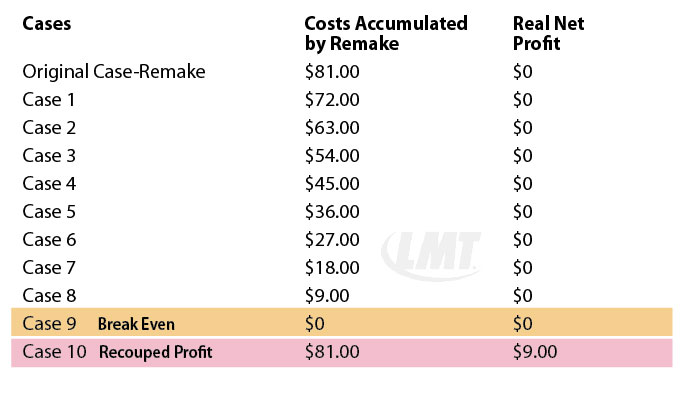
Example #1: The laboratory sells the unit for $90 and the cost of goods sold is $81 for a net profit of $9 (10% net profit margin). It would take nine cases to reach the break-even point, with the 10th case recouping the lost profit on the remake.
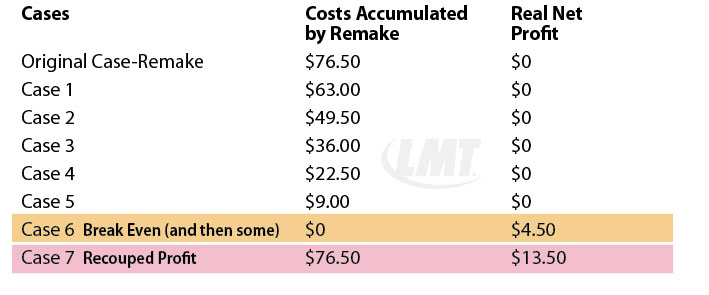
Example #2: The laboratory sells the unit for $90 and the cost of goods sold is $76.50 for a net profit of $13.50 (15% net profit margin). Here, it takes less than six additional cases to reach the break-even point; the sixth case generates $4.50 of profit.