PMMA, Technopolymers Spike in Popularity

Posted Nov 27, 2018 in LMT Surveys

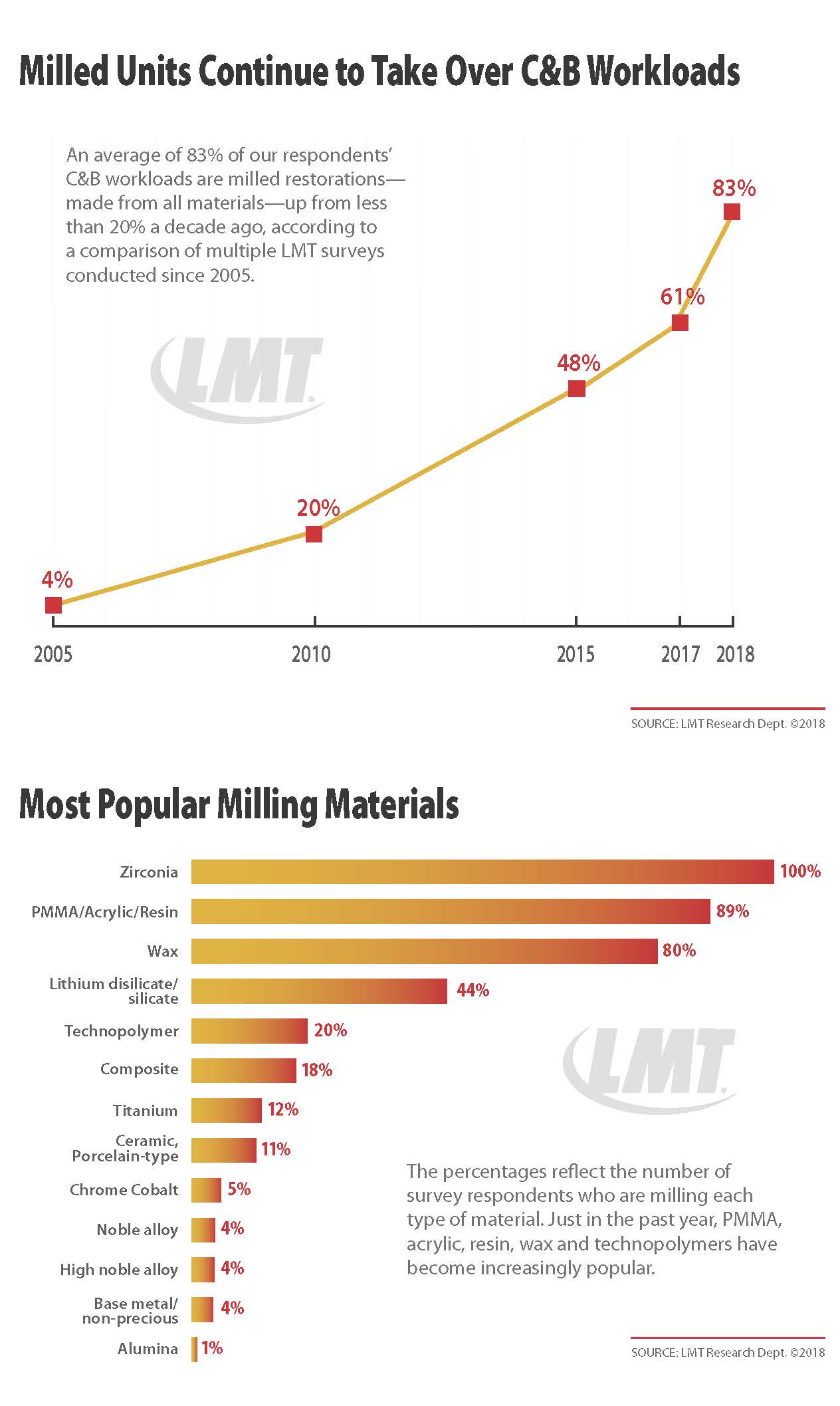
While zirconia still leads the list of the most popular milling materials, there has been a significant shift in usage of other materials just in the past year. For example, a comparison of our 2018 Milling Survey and 2017 Digital Technology Survey shows that the number of respondents using PMMA, acrylic, resin and wax has doubled and those milling technopolymers (PEEK, PEKK, AKP, etc.) has quadrupled. There’s also been a notable decline in milling noble and high noble alloys.
Among our 2018 respondents, milled restorations make up an average of 83% of their C&B workloads, up from less than 20% a decade ago (see chart below). Two thirds have at least one mill in their laboratory—and the vast majority are happy with their purchases as well as the efficiency of the milling workflow.
“Buying a mill was the best step I made for my small lab. I feel like I’m in control again. I thought just having a scanner would be enough but once I committed to purchasing a mill and moved forward, I wished I hadn’t waited so long,” says Rick Cutforth, Owner, Northern Lights Dental Lab, Idaho Falls, ID.
Users also tout the enhanced profitability of milling, provided you have the demand to use the mill at capacity. “The profitability of milling is considerably higher. It’s beneficial because we can experiment and more readily expand into other offerings like PMMA, surgical guides and splints,” says Timothy Moore, President, Creation Dental Ceramics, a small lab in Red Wing, MN.
Among the two thirds who have a mill, one quarter of them plan on buying at least one more unit within the next year. The top criteria for purchasing that new mill: accuracy, speed, cost, ease of use, reliability and technical support. “I also look at the warranty; spindle life; consumable costs, primarily burs; and ease of tool paths and maintenance,” says Rob Gitman, General Manager, NDX Thayer, Mechanicsburg, PA.
More than 60% of our survey participants say the manufacturer/supplier from which they purchased their mill was “very accurate and honest” when explaining the applications, features, tooling requirements and warranties. However, some of the chief complaints among those who feel their manufacturer/supplier was less than forthcoming include failure to explain all of the available options, such as upgrades and additional purchases required, and lack of thorough knowledge among the sales reps.
Jon Gaich, part owner, SmartLab Inc., Greensburg, PA, warns about inconsistent information and support. “We’ve gotten several versions about how and when the machine should be maintained. We learned one thing during training and then each technical support person told us something different. For example, when it comes to cleaning and greasing the collet, we’ve heard once a month, once a week, once a day or even that it depends on how many units we mill. We had to come up with our own daily, weekly and monthly schedules for maintaining the mills, vacuums, compressors and even air dryers,” he says.
Another issue: overpromising the ease of transition. “There’s always a learning curve to new equipment and to go from hands-on to digital. Some reps minimize this factor greatly in order to make a sale. Do your homework and be sure you can manage that curve!” says Linda McGee, CDT, President, Suncoast Ceramic Studio, Inc., a medium-size lab in Brandon, FL.
* Our esurvey data is based on 248 responses from U.S. lab owners, managers and department heads: 56% are C&B labs, 31% are full service and 13% are removable prosthetic labs. Seventy-six percent employ up to five people; 17% have six to 21 employees and 7% have more than 21 staff members.